Soft launch vs hard launch is one of those questions that sounds like it needs a single right answer. It doesn’t. For most solo SaaS founders, the right answer is both, done in the right order. But that only makes sense once you understand what each one actually is and what it’s good for, so let’s start there.
I run Nick Launches, a launch platform, and I’ve watched a lot of products go out the door. The pattern I see over and over: founders who treat this as an either-or decision usually pick wrong, and the ones who treat it as a sequence tend to have a much better launch day.
This is for founders who are a few weeks out from shipping and trying to decide how loud to be, and when.
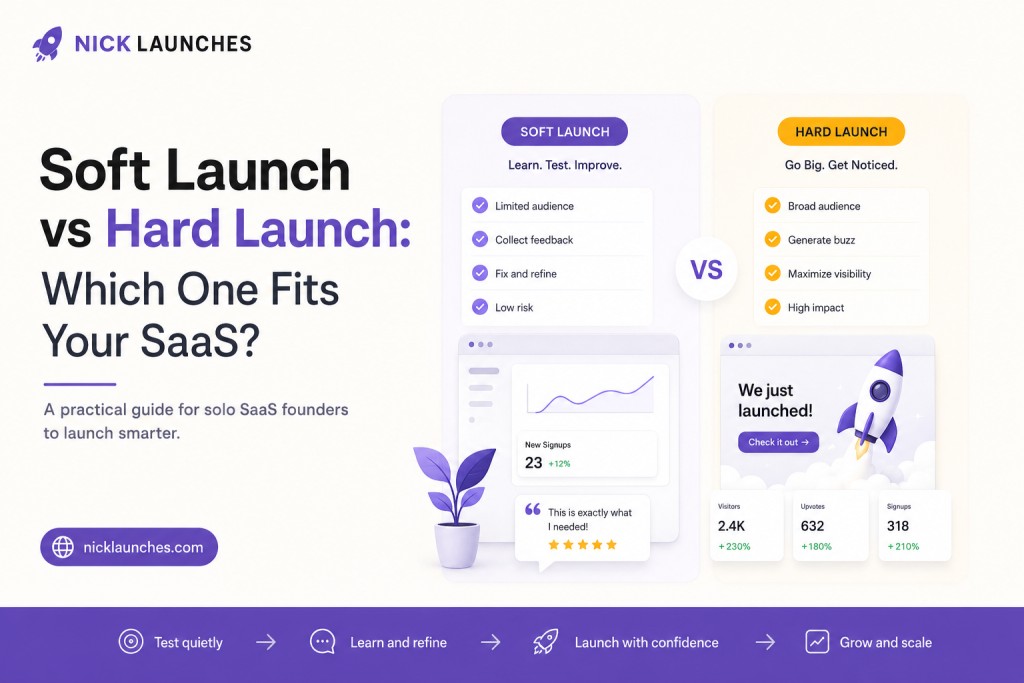
What is a soft launch
A soft launch is a quiet release to a limited audience before you make any noise publicly. No press, no big announcement, no coordinated push. You put the product in front of a small group, on purpose, and you watch what happens.
For a SaaS in 2026, a soft launch usually looks like some mix of the following. You open signups to a slice of your waitlist instead of all of it. You list quietly on a handful of curated launch directories rather than announcing anywhere loud. You share the link in one or two small communities where you already have some credibility. You email a short list of people who said they’d try it.
The goal isn’t attention. The goal is information. You’re trying to find out whether onboarding actually works when a stranger runs it without your help, whether the pricing you picked survives contact with real buyers, whether the core feature holds up under real use, and whether you can get a few honest testimonials before anyone with an audience is watching.
Quietly listing on a handful of curated directories is a classic soft-launch channel for exactly this reason. It sends a trickle of real visitors, not a spike, and those visitors tend to be people specifically looking for a new tool in your category rather than a general audience clicking a tweet. I maintain a catalog of launch directories for this reason. It’s a low-pressure way to get first users and first feedback while you’re still fixing things, and the listings themselves start building a foundation of backlinks you’ll want in place before launch day anyway.
What is a hard launch
A hard launch is the opposite move: a coordinated public push on a specific launch day, aimed at concentrating attention in a short window instead of trickling it out.
Hard launch meaning, in practice, is everything happening at once. You pick a date. You submit to launch platforms and time the listing to go live that morning. You send the announcement to your full newsletter. You post across social at once instead of staggering it. If you’ve got any press or influencer contacts, that’s the day they hear from you too. The whole point is to get as many eyes on the product as possible in the same 24 to 48 hours, because momentum in these things is genuinely self-reinforcing: early traction on a launch platform tends to produce more visibility, which produces more traction.
A good launch-day push usually runs through a platform built for exactly this kind of coordinated release. Go-Publicly is one option built around that, a place to schedule and run the actual launch-day push rather than assembling one from scratch. Hard launches work because everything lands together, not because any single piece is loud on its own.
Soft launch vs hard launch: the real differences
| Soft launch | Hard launch | |
|---|---|---|
| Goal | Learn and fix | Concentrate attention |
| Audience | Small, self-selected | Broad, public |
| Timing | Rolling, no fixed date | One coordinated day |
| Risk if something breaks | Low, few people notice | High, everyone notices at once |
| What you learn | Bugs, onboarding gaps, pricing signal, first testimonials | Market interest, positioning, how the product reads to strangers |
The table makes the tradeoff obvious. A soft launch is forgiving. If your onboarding has a broken step or your pricing page confuses people, a handful of early users hit it and you fix it before it matters. A hard launch is not forgiving in the same way. If that same broken step is live on launch day, a much larger number of people hit it in the same few hours, and you don’t get a second first impression.
That’s the entire tension. Soft launches trade scale for safety. Hard launches trade safety for scale.
When a soft launch alone is enough
Sometimes you don’t need a hard launch at all, at least not yet.
If your product serves a narrow niche where growth happens through word of mouth and direct relationships rather than broad awareness, a big coordinated push may not move the needle much. If you’re still validating whether people will actually pay, spending a launch day’s worth of attention before you know that is a waste of a scarce resource. If your onboarding is fragile enough that you’re not confident it survives a stranger with no guidance, more traffic just means more people bouncing at the same broken step. And if you don’t have a specific piece of news, a real version bump, a feature that changes the pitch, a milestone worth mentioning, then a hard launch has nothing to concentrate attention around. It ends up loud without being interesting.
In any of these cases, keep running the soft launch strategy longer. Get more signups, more usage, more testimonials, more confidence in the pricing. There’s no rule that says you owe the market a hard launch on any particular timeline.
When to go straight to a hard launch
The opposite case exists too, though it’s less common for a brand-new SaaS. If you already have a warm audience, an existing product with a proven onboarding flow, and a specific, newsworthy update, a big version release, a pivot, a major integration, then a hard launch without a preceding soft phase can make sense. You already know the fundamentals hold up because they’ve been in production. What you’re launching is the news, not the product.
That’s the exception, though, not the default. Most solo SaaS founders shipping a first product don’t have that foundation yet, which is exactly why the sequence below tends to be the better call.
The sequence that works
For most people asking soft launch vs hard launch, the honest answer is: do the soft launch first, then use what you learned to run a hard launch two to six weeks later.
The soft launch phase is where you fix the bugs a stranger finds in the first five minutes, collect two or three testimonials you can actually use in copy, confirm the pricing doesn’t cause instant hesitation, and prove that onboarding survives someone who has never talked to you. None of that is glamorous, but all of it is exactly what makes a hard launch land instead of fizzle. A hard launch amplifies whatever is true about your product on launch day. If what’s true is “solid product, a few real testimonials, onboarding that works,” amplifying that is great. If what’s true is “untested product, no social proof, a pricing page nobody’s seen,” amplifying that just gets a bigger audience to notice the same problems faster.
So the sequence is deliberate: soft launch until the evidence is in your favor, then hard launch on the evidence. Not on hope.
A practical checklist for each phase
Before you soft launch:
- Product works end to end for someone with zero context
- A small segment of your waitlist or community is ready to try it
- You have a way to actually hear feedback (a form, a DM, an email you check)
- Pricing is live, even if it’s not final
Before you hard launch:
- Onboarding-breaking bugs from the soft launch are fixed
- You have real testimonials, not hypothetical ones
- Pricing has survived contact with paying or near-paying users
- You have a specific date and a plan for what happens on it
- You’ve picked the launch platforms and channels you’re pushing through, so nothing is being figured out that morning
Where to start
If you’re not sure which phase you’re in, you’re probably still in the soft launch one. Get the product in front of a small group, quietly, and fix what breaks. A catalog of launch directories is a reasonable place to start that quiet phase, since it puts you in front of real, interested visitors without asking you to make any noise you’re not ready for yet. When the bugs are fixed, the testimonials are in hand, and the pricing has held up, that’s your signal to move to the hard launch and put real coordination behind launch day.
Disclosure: This article was contributed as part of a content partnership between Nick Launches and Go-Publicly.

Founder and builder working on internet products and startup tools. Passionate about launching simple platforms that help makers showcase their work and reach early users.