Is directory submission for SEO still worth your time in 2026, or is it a leftover tactic from the early 2000s? For a brand-new SaaS, the answer is a clear yes, as long as you pick the right directories and do it the right way.
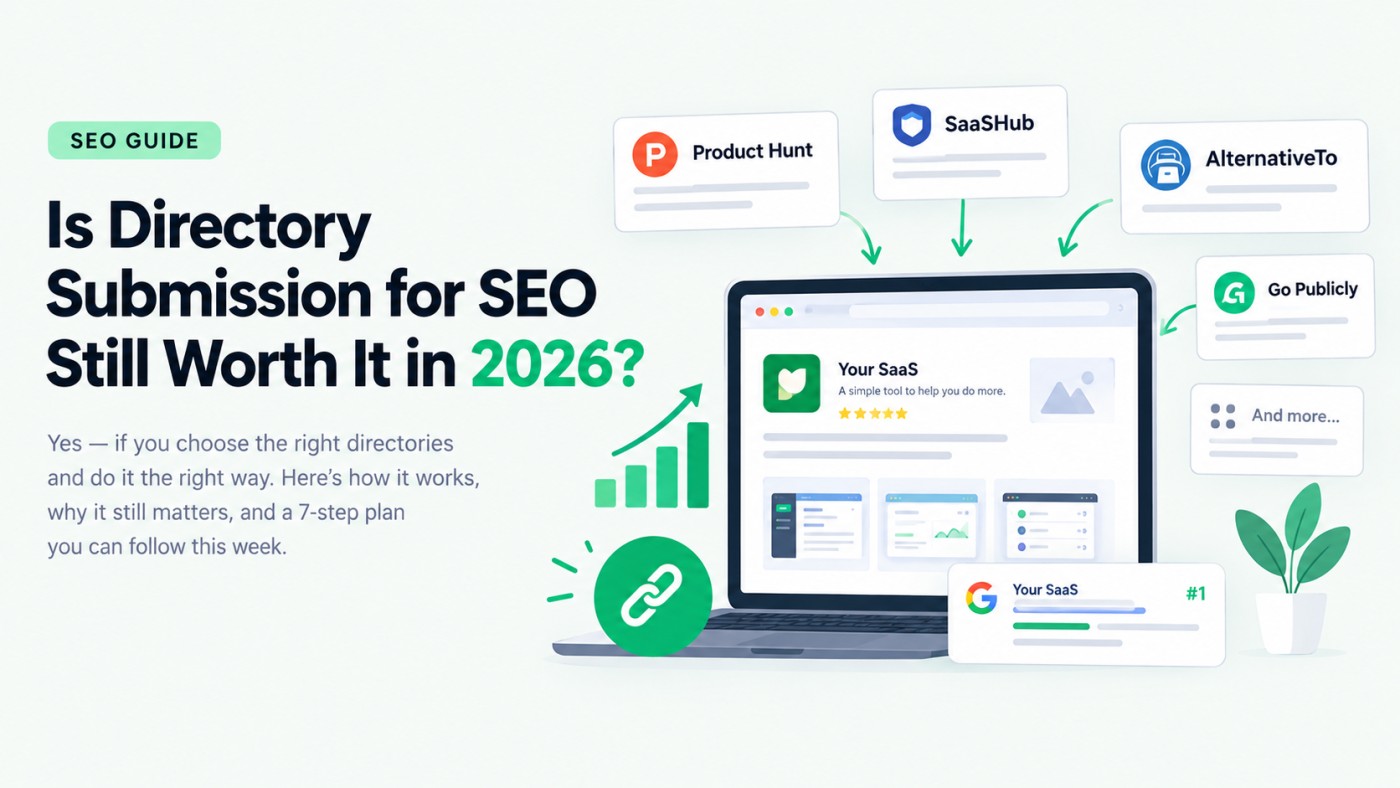
You shipped your SaaS. It works. And almost nobody can find it. For a new domain, that’s normal. Google doesn’t trust a site with zero backlinks, so your pages sit on page 8 while older competitors take the clicks. Directory listings are one of the fastest ways to change that.
This guide explains how directory submission for SEO works today, what separates a helpful directory from a harmful one, and a 7-step process you can follow this week.
What Is Directory Submission for SEO?
Directory submission means listing your product on websites that catalog startups, SaaS tools, AI apps or software alternatives. A typical listing includes your product name, a short description, a logo, screenshots, a category and a link back to your site.
From an SEO point of view, each listing does three things: it gives search engines another path to discover your site, it adds a backlink to your domain, and it creates a page about your brand that can rank for your product name.
Does Directory Submission Still Work in 2026?
It depends on which directories you mean.
The old way doesn’t work. In the 2000s, “directory submission” meant blasting a URL into thousands of low-quality web directories. Google’s spam policies treat manipulative link schemes as spam, and those links are ignored at best.
The modern way does. Today’s startup and SaaS directories are curated, have real visitors browsing for tools, and often rank well in Google themselves. A listing on one of them sends real referral traffic and is a link Google is happy to count.
Why Directory Submission for SEO Matters for a New SaaS
1. Your first backlinks
A brand-new domain usually has a Domain Rating (DR) of 0. Quality directory listings are among the easiest backlinks a new product can earn, and they help search engines discover and trust your site sooner.
2. Referral traffic from people who are actually shopping
People browse directories because they’re looking for a tool. That’s a much warmer visitor than someone scrolling social media, and a single well-placed listing can send signups for months.
3. Branded search and AI visibility
When someone Googles your product name, directory profiles fill page one with consistent, trustworthy results. They also give AI assistants more sources to learn what your product does, which matters as more people ask ChatGPT or Claude for tool recommendations.
4. Social proof
Upvotes, reviews, “Product of the Day” badges and launch rankings all give visitors a reason to trust a product they’ve never heard of.
Good Directories vs. Bad Directories
| Helps your SEO | Wastes your time (or hurts) |
|---|---|
| Focused on startups, SaaS, AI or your niche | “Submit any website” general link directories |
| Real traffic and an active community | No visitors, pages full of ads |
| Listings are reviewed by a person | Every submission approved instantly |
| Ranks in Google for its own category pages | Not indexed in Google at all |
| Clear pricing, or free | Pay-for-link schemes with no audience |
A quick test: search site:directoryname.com in Google. If almost nothing shows up, Google doesn’t value that site, and a link from it won’t help you either.
7 Rules for Directory Submission for SEO
1. Build a launch kit first
Prepare a 60-character tagline, a 160-character tagline, short and long descriptions, a square logo (512×512 or larger) and 3–5 screenshots. Every submission then takes minutes instead of an hour.
2. Write unique descriptions
Don’t paste the same paragraph everywhere. Write two or three variations and rotate them, so each listing reads as its own page.
3. Start with the most relevant directories
Begin with launch platforms like Product Hunt and Go Publicly, alternative finders like AlternativeTo and SaaSHub, and any directories built for your niche. Need the full list? Our list of 200+ SaaS directories lets you filter by type, link type and DR.
4. Mix dofollow and nofollow
Dofollow links pass ranking value, but nofollow listings on busy sites still send traffic and brand searches. A natural link profile has both.
5. Pace your submissions
Submit in batches over a few weeks rather than 100 in one afternoon. It’s easier to manage, and your backlink growth looks natural.
6. Track everything
Keep a spreadsheet with the directory, date submitted, status, listing URL and link type. Add UTM parameters (for example ?utm_source=saashub) where allowed, so you know which directories send signups.
7. Follow up and keep listings fresh
Check pending reviews after a week, and update your listings when you ship major features or change pricing. Stale listings convert worse.
How Long Does Directory Submission Take to Work?
Some listings go live within days; others sit in review for weeks. Search engines then need time to crawl and count the links. Plan on several weeks to see movement in your Domain Rating, and a few months for the full effect on rankings. Directory submission for SEO is a foundation, not a shortcut: it gets your new site out of the “unknown domain” bucket so your content and other marketing work better.
Want It Done for You?
Submitting to 20 directories yourself is very doable. Submitting to 100+ takes days of form-filling, account creation and email verification. If you’d rather spend that time building, our directory submission service submits your product to 100+ directories for a one-time $100 and sends you a completion report.
Just launching? Start by launching your product on Go Publicly for free. No credit card, about 5 minutes to set up.
FAQ
Is directory submission good for SEO?
Yes, when you choose relevant, curated directories. Directory submission for SEO gives new sites early backlinks, referral traffic and branded search results. Mass submissions to low-quality web directories don’t help and can hurt.
How many directories should I submit to?
Start with the 10–20 most relevant directories for your niche. If you want faster domain growth, expand to 50–100+ quality directories over the following weeks.
Are dofollow links from directories better?
Dofollow links pass more ranking value, but don’t skip a high-traffic directory just because its links are nofollow. The visitors and brand exposure are still worth it.
Are paid directory listings worth it?
Sometimes. A paid listing on a site with real, relevant traffic can pay for itself. Check the directory’s traffic and audience before you pay, and track signups with UTM links.

Founder and builder working on internet products and startup tools. Passionate about launching simple platforms that help makers showcase their work and reach early users.